


Managing invoices and general ledger coding shouldn’t slow your finance team down, but manual reviews, inconsistent classifications, and long onboarding cycles often do. AI invoice processing changes that.
By learning directly from your company’s historical data and chart of accounts, AI accounting software automates coding accuracy from day one. It adapts to each entity’s rules, eliminates repetitive work, and accelerates approvals through intelligent AP automation.
Whether you’re handling hundreds or thousands of invoices, AI for accounts payable delivers precise, automated invoice processing that cuts errors, saves time, and keeps your general ledger accurate, without adding complexity.
How does accounting AI learn from your general ledger?
Just like accountants improve through experience, AI accounting software improves by learning from vast amounts of data. Two factors determine how accurately it classifies costs: the sophistication of its algorithms and the depth of its training data.
AI for accounts payable systems like Vic.ai are trained on vast datasets, billions of invoices spanning industries, to identify patterns in vendors, cost types, and GL structures. When paired with your own historical data, this foundation enables accurate automated invoice processing from day one.
Even without prior company data, AI invoice processing quickly learns from user feedback. Each correction by your accounts payable team helps the AI model adapt to your unique GL setup, allowing it to code invoices with minimal supervision automatically.
Unique local general ledger accounts
Every business, and often each entity within it, has its own general ledger, accounts, projects, and cost dimensions. This complexity can overwhelm human teams managing multiple entities, leading to fatigue, classification errors, and inefficiency.
With AI for accounts payable, entity switching becomes effortless. The system supports each entity’s chart of accounts and learns granular differences automatically. Vic.ai combines a global understanding of accounting concepts with local, entity-specific learning, ensuring accurate, context-aware GL coding for every organization it supports.
In practical terms, your finance team gains a digital colleague that understands each entity’s nuances and delivers consistent accounts payable automation, even as the team scales or changes.
AI promises to do something different than what we’ve seen before. While it’s very easy for the human brain to understand a rule, machine learning is very different from a rules-based system. Machine learning is smarter because it uses big data and has super-human memory that makes it possible to follow trends in real-time.
Why machine learning outperforms rules-based automation
Traditional automation relies on static rules, but invoices are dynamic. Vendors change, descriptions vary, and cost categories evolve.
AI invoice processing uses semantic understanding and pattern recognition instead. If it learns that Uber and Lyft are transportation vendors, it can also recognize new ones like Bolt or Grab without additional setup. Each time your AP team confirms a classification, the AI strengthens its internal model, building an ever-smarter automated invoice processing system.
This adaptive learning means less manual rule maintenance, higher accuracy, and smoother scalability across all your entities.
Confidence levels and human collaboration
AI accounting software doesn’t just predict, it explains. Every decision comes with a confidence score that lets your team instantly see whether human review is required. For example, Vic.ai shows a green, yellow, or red label to signify AI confidence. When confidence is high, invoices can move straight through Autopilot for true automated invoice processing. When confidence is lower, they’re automatically flagged for verification before posting.
This balance between automation and oversight is what makes modern AP automation effective. Your team reviews only what’s necessary, focusing on exceptions and high-value analysis instead of repetitive checks. Over time, as AI invoice processing learns from these interactions, accuracy continues to improve, bringing your finance team closer to complete autonomy.
With continuous feedback from your AP team, AI for accounts payable becomes smarter and more precise over time. The result is faster approvals, fewer manual touches, and a streamlined workflow that supports finance leaders’ goals for speed, accuracy, and control.
So how does machine learning apply to invoice processing?
Machine learning utilizes large amounts of data and information to give you the best recommendations for processing and cost classification. Through the use of sophisticated algorithms, the AI has step-by-step instructions on how to read your invoice and uses the information provided to deduce the General Ledger account classification. Additionally, the more the AI is used, the more it learns from your interactions and patterns, therefore becoming more versed in the variety that often occurs in invoices.
With systems like Vic.ai, the more it is used, the smarter the system becomes, allowing it to become more accurate over time and eventually operate independently.
It reads the contents of the accounts payable documents and looks through the entire sheet to determine the best recommendations for your invoice number, the date of purchase, vendor information, or any other key information. This really helps to make the process more efficient and keeps it running smoothly.
Enhancing your business applications with AI algorithms can transform your accounts payable workflow entirely, allowing you to perform tasks more efficiently and accurately.
The power of integration and visibility
Modern finance tools don’t work in isolation. Vic.ai integrates seamlessly with ERPs like NetSuite, SAP, and QuickBooks, feeding insights directly into your accounts payable automation workflows.
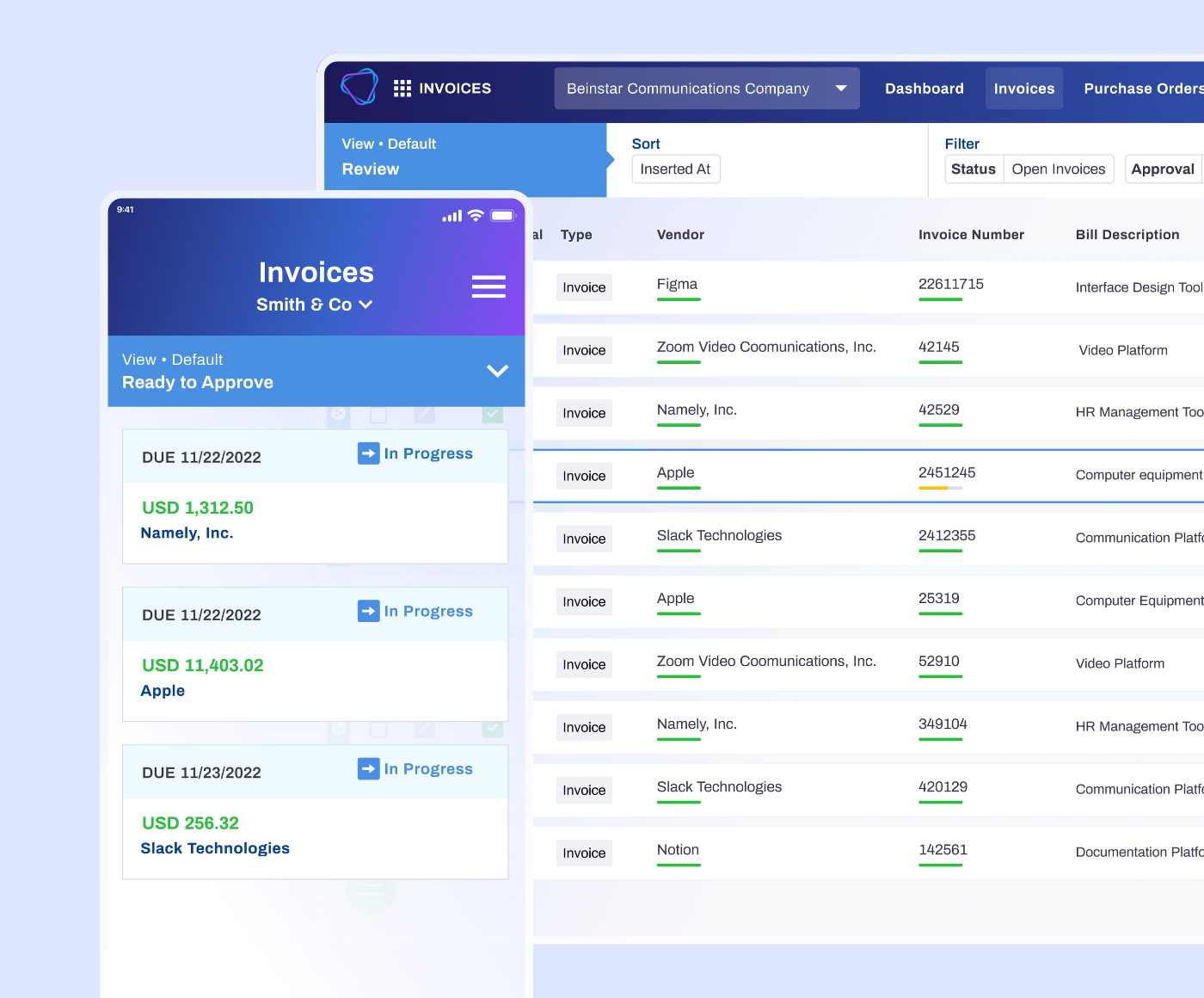
Through unified dashboards, your finance team can track every stage of invoice handling, from ingestion to GL posting, with complete transparency. This visibility turns AI invoice processing from a back-office utility into a strategic asset that supports forecasting, compliance, and financial planning.
As a result, organizations adopting AI for accounts payable report faster cycle times, fewer errors, and greater control across their accounting operations.
Reimagine your financial operations with artificial intelligence for accounting and invoice processing
AI invoice processing and AI accounting software aren’t futuristic concepts anymore; they’re reshaping how finance teams work today. By automating invoice intake, coding, and posting, Vic.ai empowers AP departments to move beyond manual entry and focus on strategy.
With automated invoice processing and scalable AP automation, teams can reduce manual workloads, maintain accuracy, and gain actionable insight from every transaction. It’s not just automation, it’s transformation.
Ready to modernize your accounts payable? Discover how AI for accounts payable can streamline your processes, strengthen compliance, and unlock true financial efficiency.
Are you ready to enter the new era of accounting and upgrade your invoice processing software?
Begin your autonomous accounting journey with a solution that understands and works alongside your AP function, and is not limited to a predetermined set of rules that, in many ways, further complicate accounting. Book a demo with Vic.ai today.
Frequently asked questions:
What is AI invoice processing?
It’s the use of AI accounting software that automatically reads, classifies, and codes invoices into your general ledger, reducing manual effort and improving accuracy.
How does AI for accounts payable differ from standard automation?
Traditional tools follow rules. AI for accounts payable learns continuously from your data, adjusting classifications and improving results over time.
What’s the benefit of automated invoice processing?
It speeds up approvals, eliminates repetitive data entry, and gives finance leaders real-time visibility into cash flow and expenses, all while improving GL accuracy.
This article originally published March 2022, and was updated February 2026.



.png)


.svg)


