


AI is no longer a future concept in finance. Adoption is rising, investment plans are growing, and leadership support is strong. But beneath that momentum, a quieter reality is shaping how far and how fast AI can actually scale.
According to the Vic.ai 2025 AI Momentum Report, a survey of nearly 800 finance and AP professionals, 72% of organizations now use AI in finance or accounts payable, and 82% plan new AI investments in the next 12 months. More than 80% say leadership is supportive of AI adoption.
And yet, when finance teams talk about what’s holding them back, the barriers aren’t about access or ambition — they’re about trust: accuracy, security, reliability, and accountability.
In finance, trust isn’t a nice-to-have. It’s the currency that determines whether AI is cautiously supervised, or confidently scaled.
AI is the next era of enterprise technology
Part of the hesitation around AI comes from how new it feels. But in reality, AI follows a familiar pattern.
ERP systems didn’t transform finance overnight. Cloud adoption took years of new security models, governance frameworks, and uptime benchmarks before it became standard infrastructure. Even automation tools required time, process redesign, and oversight before they delivered real value. AI is no different.
However, it does introduce powerful new capabilities — and new responsibilities. It requires structure, process, guardrails, and time for organizations to learn how to use it well. Finance teams aren’t resisting AI; they’re doing what they’ve always done with major technology shifts: asking for more information and proof.
As one Momentum survey respondent put it simply: “AI is promising, but it’s still early. We need time to understand it and trust it.”
The data shows momentum — and caution
The survey data reflects this dual reality clearly. On one hand, adoption is accelerating:
- 74% of executives report using AI, compared to 50% of staff
- 64% of respondents view AI as a productivity enhancer, not a replacement
- 79% of organizations using AI report measurable benefits, including faster processing and improved employee satisfaction
On the other hand, trust-related concerns remain the top barriers:
- 47% cite data privacy or security concerns
- 40% worry about incorrect outputs
- 51% say system integration challenges slow adoption
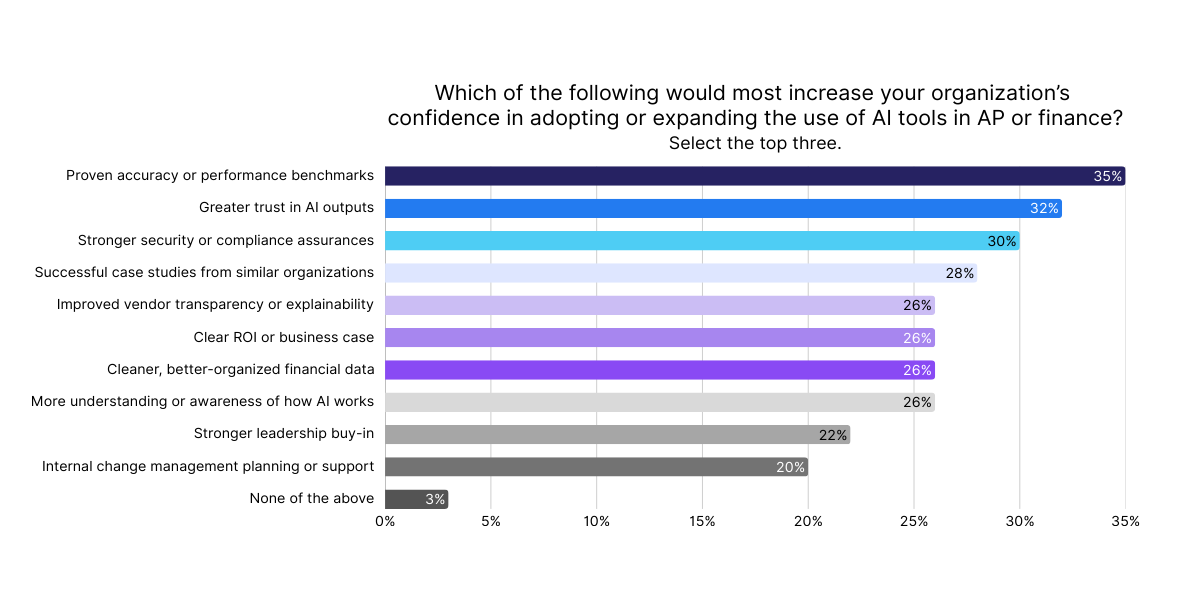
- 35% say proven accuracy is the #1 driver of confidence in AI
Staff-level comments make the hesitation tangible:
“AI helps, but there’s still a lot of manual review. We don’t trust it completely yet.”
“There’s a belief that AI will catch everything, but we still double-check most of its work.”
This isn’t fear; rather, it’s stewardship. Finance teams are responsible for accuracy, compliance, and auditability. They can’t afford blind trust.
Why trust matters more in finance than anywhere else
In many parts of the business, experimentation is encouraged and mistakes are recoverable. In finance, errors have consequences — regulatory, financial, and reputational.
That’s why manual review persists even as automation expands. The AI Momentum Report found that 37% of AP teams still cite manual data entry as their top pain point, and 44% still rely on some form of manual entry despite modern systems.
One survey respondent expressed concern about trusting the technology: “False sense of security. The workflow is faster, but people assume AI is always right.”
Until AI applications earn trust within a specific organization, consistently and visibly, finance teams will continue to supervise it closely, and should.
AI doesn’t have to be a black box
A common fear is that AI is opaque or uncontrollable. But that perception often stems from a lack of knowledge and measurement, not a lack of capability.
The Momentum report shows that only 18% of AP teams track advanced automation metrics like no-touch or straight-through processing rates. Without visibility into how often AI works independently — and how accurately — trust has nowhere to grow.
As one respondent noted: “We don’t always understand how the system makes decisions, which makes it harder to rely on.”
When performance is measured, audited, and benchmarked, AI stops feeling like magic and starts behaving like infrastructure.
How finance leaders can build trust the right way
Trust isn’t built by moving faster; it’s built by moving deliberately. As AI becomes more embedded in finance workflows, leaders must approach adoption with the same rigor they apply to any core financial system.
Peer validation plays a major role. Finance teams are far more likely to trust AI when they see similar organizations using it successfully. Benchmarks, case studies, and shared experiences help normalize adoption and reassure teams that AI performance isn’t theoretical — it’s proven in comparable environments.
A strategic and thorough buying process matters. Trust begins long before implementation. Finance leaders should carefully vet AI tools for accuracy, transparency, security, and auditability — not just features. Understanding how a system learns, how it handles exceptions, and how it integrates with existing ERP and controls helps teams feel confident that AI is built for financial-grade use. Rushing selection can undermine trust later, while thoughtful evaluation sets a strong foundation for adoption.
Measurement builds confidence over time. Tracking accuracy trends, exception rates, no-touch processing, and time-to-value allows teams to see improvement, not just isolated wins. Evidence replaces assumption, and performance data becomes the basis for trust.
Governance and guardrails are equally critical. Teams need clear rules around when AI acts, when humans intervene, and how decisions are logged and reviewed. Defined escalation paths and audit trails make AI predictable rather than opaque — reducing anxiety and reinforcing accountability.
As one respondent shared: “Once we understood the guardrails and where human review fits, we felt more comfortable letting AI do its job.”
Together, these elements turn AI from a promising tool into a trusted system, one that finance teams can rely on with confidence.
Trust is cultural, and it takes time
Trust doesn’t come from announcements or dashboards. It comes from experience. The perception gap highlighted elsewhere in the report — executives optimistic, staff cautious — underscores this. 43% of respondents say training is critical to successful AI adoption, yet many teams still feel underprepared.
“Leadership supports AI, but employees weren’t prepared for the transition.”
Roles are evolving, as they always have in finance. Tasks like data entry are diminishing, while analysis, oversight, and exception handling are growing. When this evolution is communicated clearly and supported with training, trust follows.
When trust clicks, adoption accelerates
Organizations that invest in trust see tangible results. Manual review decreases. Automation scales. Morale improves. Respondents described the shift this way:
“AI reduced manual tasks and improved accuracy. The team now spends time on analysis instead of entry.”
“Less manual work, more strategic oversight — it’s made everyone’s jobs easier.”
This is what maturity looks like: not blind reliance, but confident collaboration between humans and machines.
.png)




.svg)


