





Finance leaders are embracing AI with confidence — but the people who use these tools every day aren’t always on the same page.
According to the Vic.ai AI Momentum Report, which summarizes survey findings from nearly 800 finance and AP professionals, 74% of executives say their organizations use some form of AI in finance or AP, compared to just 50% of the staff-level respondents. That 24-point spread is more than a data point; it’s a signal that two very different realities exist inside today’s finance teams.
Leaders feel momentum, but staff feel the friction. And if organizations want to scale AI successfully, those perspectives have to converge. This perception gap is natural, but it’s also risky. AI adoption isn’t just a technology project — it’s a cultural shift.
Two realities: What executives see vs. what staff experience
Executives overwhelmingly frame AI as an efficiency accelerator and a competitive advantage, and the data validates that optimism. Leadership confidence is high:
- 91% of executives say they’re confident in their financial data readiness for AI
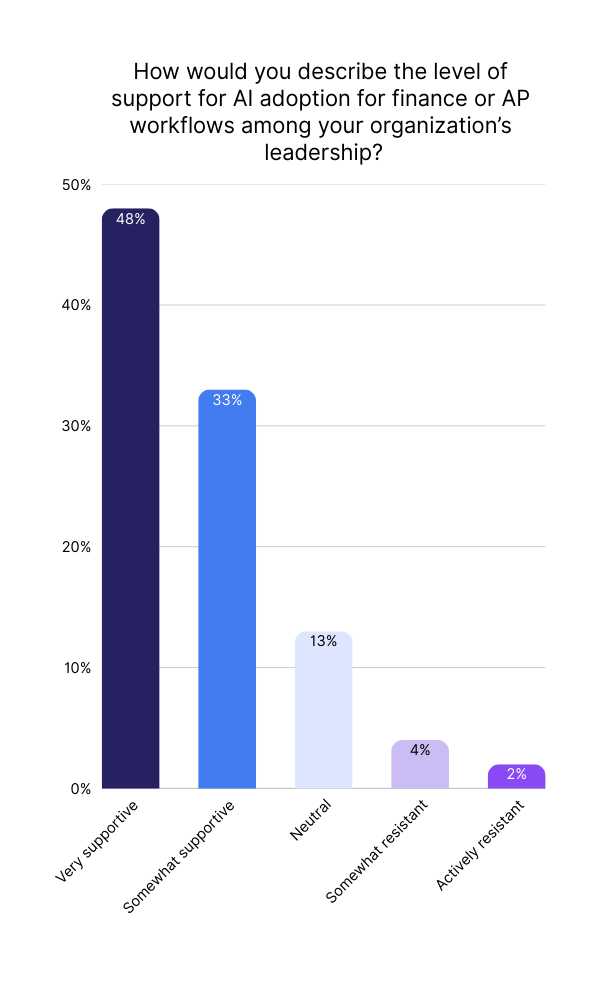
- 87% report strong leadership support for AI adoption
- 74% say their organizations already use AI in AP or finance workflows
- Many describe AI as transformative, calling it “a game-changer” that improves accuracy and speeds up decisions
These are the metrics that matter at the strategic level: readiness, support, return on investment, and organizational momentum. But staff see AI through a different lens: one shaped by hands-on workflow friction, oversight responsibilities, and unclear boundaries around control. Staff-level respondents report:
- Only 50% are actively using AI tools today
- 47% worry about data privacy or security
- 40% are concerned about incorrect outputs
- 51% cite integration challenges as a barrier
- 29% express job displacement concerns
To staff, AI isn’t just a strategy — it’s a tool they must trust, monitor, learn, and sometimes correct. They see the messy middle between early adoption and true operational maturity. A few comments from respondents illustrate the divide clearly:
“AI helps, but there’s still a lot of manual review. We don’t trust it completely yet.”
“Leadership is excited about AI, but we’re not trained enough to use these tools confidently.”
“There’s a belief that AI will catch everything, but we still double-check most of its work.”
“False sense of security — the workflow is faster, but people assume AI is always right.”
“AI is promising, but employees weren’t prepared for the transition.”
These voices reflect a consistent theme: staff aren’t resisting AI; rather, they’re navigating its imperfections. While leaders see strategic value and big-picture efficiency gains, frontline teams experience the day-to-day friction: unclear boundaries, inconsistent outputs, limited training, and the weight of accuracy and compliance. The perception gap isn’t about rejection; it’s about trust, readiness, and the lived reality of using AI in high-stakes financial workflows.
Why this gap exists
1. Visibility
Executives tend to see AI from a high altitude: strategic dashboards, cycle-time improvements, cost reductions, and the promise of real-time insights. From that vantage point, AI looks clean, measurable, and transformative.
But staff see what happens before those metrics appear. They catch the exceptions the model can’t resolve, correct mismatched vendor data, troubleshoot failed integrations, and reconcile the invoices that automation didn’t fully process. For them, AI is not just a performance driver — it’s another layer of work to manage. This difference in visibility naturally shapes different attitudes toward maturity and readiness.
2. Experience
Leaders interact with AI through outputs: KPIs, analytics, variance explanations, and accuracy benchmarks. Their impression of the technology is shaped by what it produces.
Staff interact through the inputs: the day-to-day clicks, uploads, validations, and exception handling required to keep the workflow moving. When automation misreads a field, misclassifies a vendor, or flags too many invoices for review, it’s frontline staff who feel the slowdown.
So while executives experience AI as “faster and smarter,” staff often experience it as “mostly helpful, but still incomplete.”
3. Change fatigue
Many AP teams have undergone multiple rounds of automation — including OCR tools, workflow systems, and RPA scripts — each promising significant efficiency gains. But because few solutions deliver full straight-through processing, the burden of manual review has never fully gone away.
This history creates a kind of practical skepticism: not resistance to progress, but caution born from previous disappointments. Staff don’t automatically celebrate new tools; they wait to see if the technology will actually remove work rather than reshape it.
4. Psychological safety
While executives talk about transformation, staff often worry about disruption — to their roles, responsibilities, or stability. Survey respondents were candid about their fears and observations:
“AI in accounts payable may eliminate jobs.”
“Roles have changed — some employees were demoted as AI took over parts of the process.”
Even though 64% of all respondents view AI as a productivity enhancer, not a replacement, proximity to the work makes the uncertainty feel more personal. When job identity is tied to accuracy and control, handing pieces of that work to automation can feel risky without clear communication and reassurance. And the reality is, some roles are shifting — just as they have through every phase of finance modernization. Tasks that were once central to AP, like data entry and reconciliation, are becoming lighter-touch or disappearing entirely, while new responsibilities such as exception handling, analysis, vendor strategy, and compliance oversight are growing. For many, the change is an opportunity; for others, it raises questions about skills, expectations, and long-term fit.
Why leadership optimism isn’t enough
More than 80% of executives say their organization is supportive of AI for AP, and many view the technology as both inevitable and strategically essential. But enthusiasm at the top doesn’t automatically translate into competence at the desk.
Leaders often assume that once AI is implemented, teams will naturally adopt it. In reality, frontline staff must live with every exception, error, and incomplete integration the system produces. They feel the friction immediately, long before leadership sees the benefits reflected in KPIs or reporting dashboards.
This disconnect can create a predictable cycle:
1. AI is implemented with high expectations.
2. Teams use it cautiously or inconsistently, unsure how much to trust or rely on its outputs.
3. Manual workarounds reappear, as staff revert to checking, correcting, or reprocessing data “just to be safe.”
4. The expected ROI never fully materializes, not because the technology failed—but because confidence didn’t keep pace with adoption.
Survey responses reinforce this pattern. Staff frequently described having to validate AI outputs or rerun tasks the system attempted to automate:
“AI speeds up our workflow, but people still double-check everything because they’re unsure what it’s doing behind the scenes.”
“We want to use AI more, but we don’t feel we understand its decisions well enough to trust them.”
“It’s helpful, but employees weren’t prepared for the transition.”
In other words: adoption does not always equal trust. Until staff feel secure in how AI works and are confident that errors won’t fall back on them, the technology will operate below its potential. Leadership optimism is a powerful catalyst, but genuine transformation depends on whether teams understand, believe in, and can successfully collaborate with the systems put in front of them.
Bridging the gap: Where change management matters most
To get AI adoption right, organizations must move beyond deployment to cultural activation. Here’s where the data points the path forward:
1. Build trust through transparency: Confidence in AI starts with clarity. More than 35% of respondents say proven accuracy is the single biggest driver of trust, which means teams need visibility into how the system works, how often it’s right, and what happens when it’s not. Breaking down the “black box” is essential. When organizations share performance benchmarks, accuracy rates, and clear audit trails, AI becomes less mysterious and more dependable. Transparency turns uncertainty into understanding — and understanding into adoption.
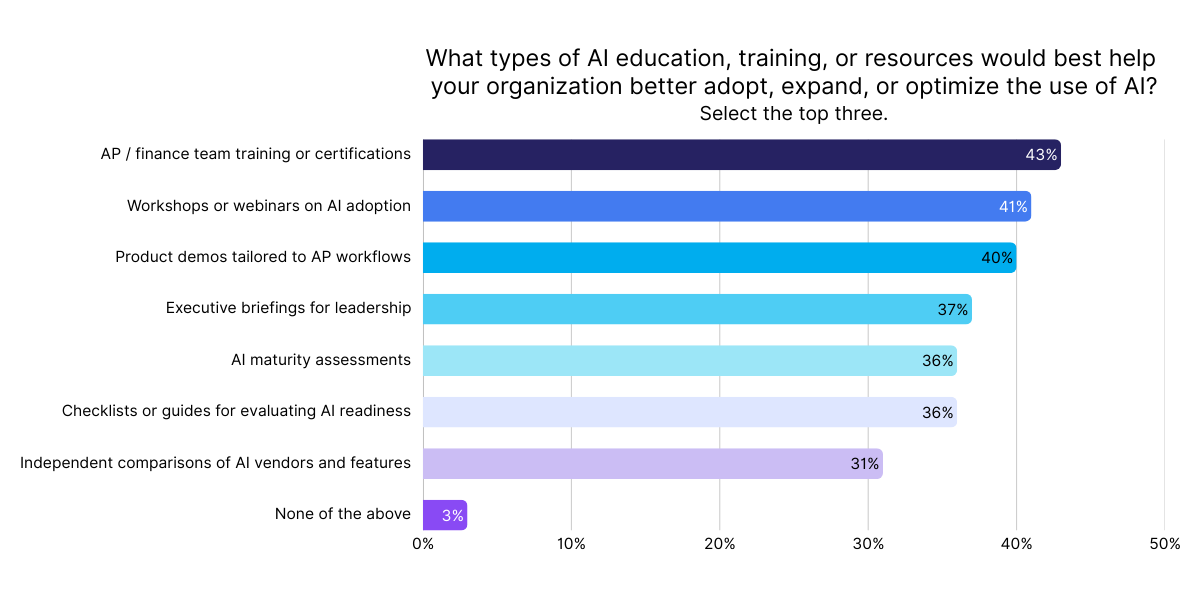
2. Upskill and empower users: Training is not optional; it’s foundational. In fact, 43% of respondents say AP team training is critical to successful AI adoption. But training can’t be a one-off webinar or a quick product demo. It must be role-based, hands-on, and continuous — designed to help employees understand not just how to use the tool, but how the nature of their work will evolve because of it. When people understand AI’s purpose and feel equipped to use it confidently, they’re far more likely to embrace it.
3. Reframe roles: The data shows that 64% of respondents view AI as a productivity enhancer, not a threat. That framing matters. Real experiences support this: respondents described AI as reducing manual tasks, improving accuracy, and creating time for more strategic work. As one person shared, “Less manual work, more strategic oversight — it’s made everyone’s jobs easier.” Another noted that the team now spends time on analysis instead of data entry. Executives must reinforce this narrative: AI isn’t replacing people — it’s raising the value of the work they do.
4. Model confidence at the top: Adoption accelerates when leaders demonstrate trust in the tools they champion. When executives use AI-driven insights, reference AI-supported decisions, or visibly rely on automated workflows, they send a powerful signal that the technology is both safe and strategic. Cultural change doesn’t begin with policy — it begins with example.
5. Create continuous feedback loops: For AI to take root, staff must be co-creators in the process, not passive recipients. Regular check-ins between AP teams, finance leaders, and IT help surface issues early, reduce workflow anxiety, and build shared ownership of the transformation. These conversations strengthen alignment and ensure that AI evolves with the people who use it. Culture shifts when communication does — and when feedback becomes part of the operating system.
Signs of progress and alignment
The organizations furthest along in AI maturity show the smallest perception gap. Operational-stage teams tend to have:
- Full ERP integration (91%)
- A defined AI strategy (82%)
- Structured KPI tracking for accuracy, speed, cost, and user satisfaction
- High team understanding (80% or higher) of what AI actually does
As organizations mature in their AI adoption, the tone of employee feedback shifts noticeably. Instead of caution or uncertainty, teams begin describing their work in new terms — more analysis, more decision-making, and fewer hours spent processing or correcting data. Many survey respondents note that automation has lifted the repetitive workload and improved morale, allowing them to focus on the higher-value responsibilities that truly require human judgment.
From top-down enthusiasm to teamwide confidence
AI success doesn’t start with technology; it starts with people. The perception gap between executives and staff isn’t a barrier; it’s a blueprint for where organizations must focus energy:
- Build trust
- Communicate transparently
- Train continuously
- Redefine roles
- Earn confidence, not just compliance
When leadership vision meets frontline trust, AI becomes more than a tool; it becomes a catalyst. The future of finance automation won’t be defined by who adopts AI first, but by who aligns their entire organization around it.
Explore the complete Vic.ai AI Momentum Report to see how finance teams are closing the gap between AI optimism and everyday adoption.



.png)

.svg)


