


Q3 is barely closed, and 2027 planning is already in full swing. Across your organization, leadership teams are reviewing priorities, weighing investments, and deciding which projects will get funded next year. If AI for AP is on your wish list, now is the time to build the business case and put a real number behind it, before your 2027 budget is locked.
Your CFO has probably heard every AI pitch by now. Half the internet added "agentic" to its homepage this year. Nobody in budget review is asking whether AI is cool anymore. They're asking what's the return, and can you prove it?
In this post, we'll walk through how to build a compelling business case for AI in AP, demonstrate its potential value, and put your team in a stronger position to secure funding before 2027 budgets are finalized.
The 2027 Budget Is Being Written Right Now. Is AP in It?
Gartner ran its CFO budget survey from September through October last year, which tells you exactly when the real decisions happen. Here's what those CFOs said:
- Three-quarters expected tech budgets to rise, and nearly 60% planned to grow finance AI spend by 10% or more (Journal of Accountancy).
- Headcount growth expectations fell from 6% in 2025 to just 2% in 2026 (Journal of Accountancy).
More money for tech, way less for new hires. But Gartner also told CFOs to fund only projects with strong business cases and measurable outcomes (CIO Dive). The AI budget is real. It just has a bouncer at the door, and the bouncer wants receipts.
Why 95% of AI Pilots Never Make It to the P&L
MIT's NANDA initiative found only about 5% of AI pilots drive rapid revenue acceleration. The rest stall with little to no measurable impact on profit and loss (Fortune). That's a lot of very expensive science fair projects.
The silver lining for AP? MIT found the biggest ROI in back-office automation, and buying from specialized vendors succeeded roughly three times as often as building in-house (Fortune).
When AP pilots fall short, it's usually for one of three reasons:
- No baseline. You can't measure how much time you've saved if you never tracked how long things took before.
- The wrong metrics. Processing 10,000 invoices sounds impressive, but how many actually made it through without someone stepping in?
- No clear next steps. The pilot has been running for months; feedback is positive, but there's still no timeline for making a decision.
The Five Numbers That Get AI Funded
Good news: almost everything AP does is already countable. You just need five numbers, measured before and after.
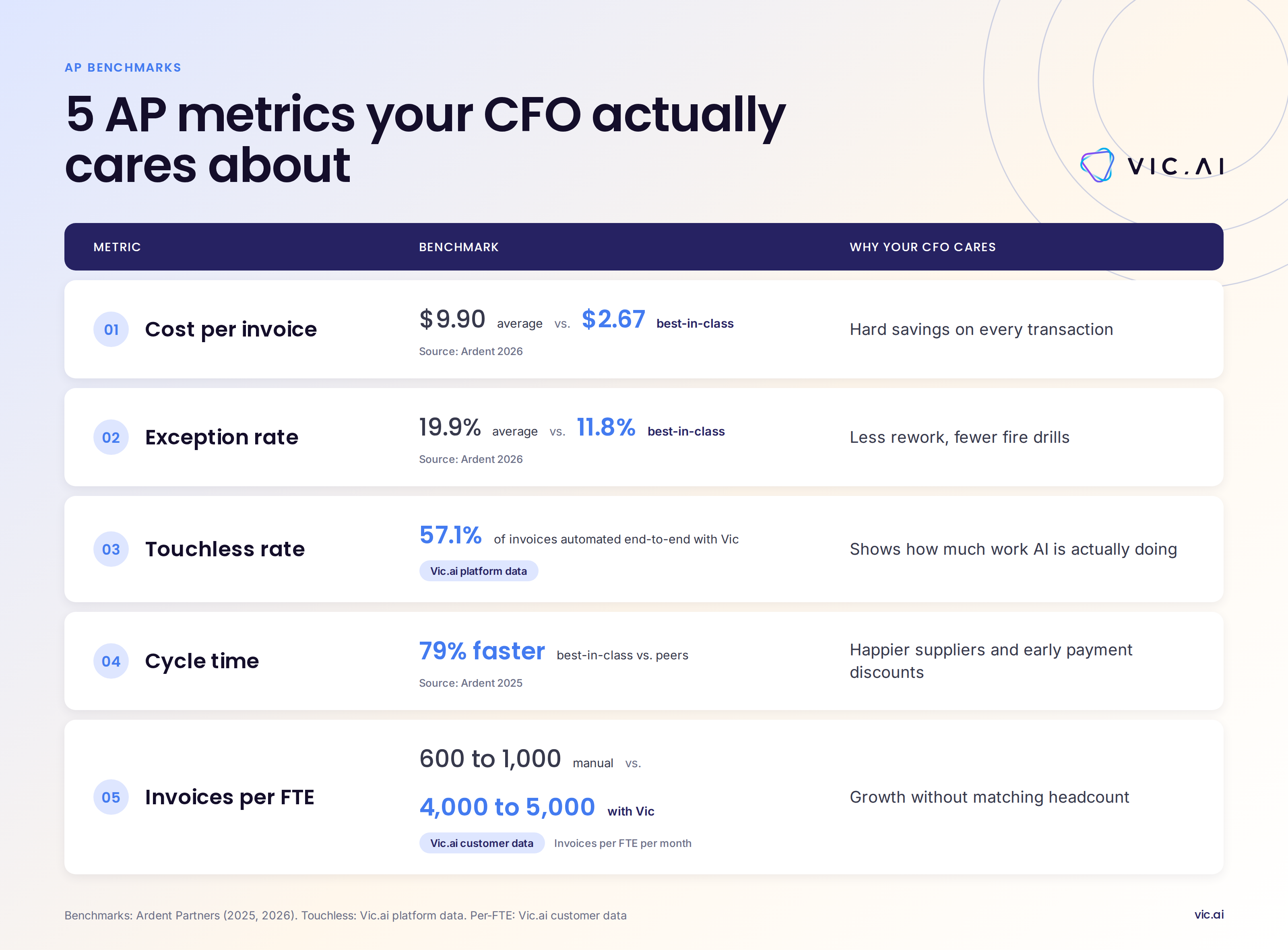
Fix the Workflow First. Then Bring In the AI.
AI is basically a brilliant new hire. Show it the process, give it clean data, tell it who signs off, and it'll do great work. Drop it into chaos, however, and you get very confident chaos. Ardent's 2026 research backs this up: the teams pulling ahead pair new tech with cleaner processes and clearer ownership (Ardent 2026).
So map the real workflow (not the one in the policy doc), clean up duplicate vendors and dead GL codes, and decide which invoices should fly through untouched. Then let AI own the volume work like capture, coding, and matching, while your team owns exceptions, controls, and cash strategy. Every correction your team makes should teach the system. AI that doesn't learn will make the same mistake politely, forever.
60 Days to a Business Case Your CFO Can't Ignore
- Weeks 1 to 2: Take the "before" pic. Pull last quarter's five numbers. Especially the ugly ones.
- Weeks 3 to 4: Pick a real slice and set the bar. One entity or invoice type with real volume, clear targets, and a decision date on the calendar.
- Weeks 4 to 7: Run it on live invoices. A pilot on your 40 cleanest vendors proves nothing to anyone.
- Week 8: Speak fluent CFO. One page with the baseline, the results, and the annualized impact. Then get in the room before the lock.
Last Call Before the Budget Locks
Nobody's going to win 2027 with the flashiest AI demo. The AP teams that win will be the ones that walked into budget review with a baseline, a real result, and a number their CFO trusts. The window to build that case is open right now, and it shuts when the budget does.
This is the stuff we nerd out on at Vic.ai every day. More than one billion invoices have run through Vic.ai, and they keep teaching us the same thing: clean workflows first, measurable outcomes always. Curious what your scorecard could look like on your own invoices? Let's talk. Bring your gnarliest exceptions. We like a challenge.
Sources
- Ardent Partners, Accounts Payable Metrics that Matter in 2026, summary page: medius.com
- Ardent Partners, The State of ePayables 2025: AP's Unfinished Journey, summary page: tradeshift.com
- Fortune, "MIT report: 95% of generative AI pilots at companies are failing" (Aug. 18, 2025): fortune.com
- Journal of Accountancy, "Corporate spending accelerating toward AI in 2026" (Feb. 18, 2026): journalofaccountancy.com
- CIO Dive, "Most finance chiefs expect larger IT budgets, 'collapsing' staff growth: Gartner" (Feb. 17, 2026): ciodive.com
- The 50,000-invoice savings figure is an illustrative calculation based on the benchmarks above.
.png)


.png)


.svg)


